
BEYOND THE LIKES: The Growing Pressure on University Students to Keep Up with Online Lifestyles.
By Grace Akinyi Ooko
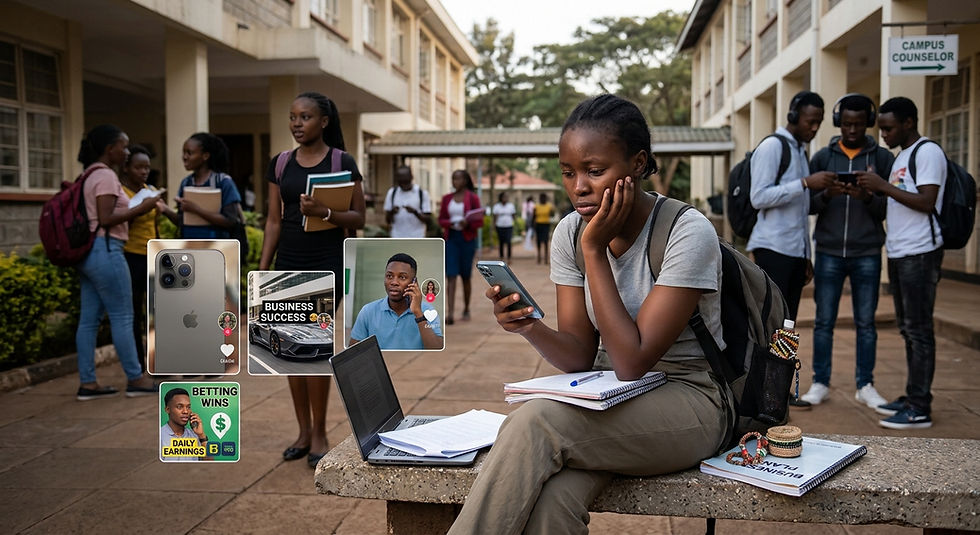
From expensive smartphones and business success to gambling and academic distractions, social media is influencing how some university students view themselves and make decisions
A few minutes on TikTok can easily turn into hours of scrolling. A student opens TikTok to watch entertaining videos, only to come across a young person showing off a new smartphone, another displaying an expensive car, and someone else talking about running a successful business.
At first, the videos may be entertaining. But after seeing people of the same age appearing to achieve so much, a student may begin to question their own progress. Why do others seem to have money, businesses and expensive possessions while some are still depending on their parents for support?
For some university students, this comparison has become part of their everyday online experience. Social media has created opportunities for learning, business promotion and communication, but it has also exposed students to lifestyles that can make them feel pressured to achieve more than their circumstances allow.
Interviews with three university students reveal different experiences. While one struggles with excessive TikTok use and comparisons with successful young people, another uses such achievements as motivation. A third of the students says pressure from friends, gambling advertisements and gaming habits have contributed to financial and academic difficulties.
Their experiences raise questions about how social media is shaping students' attitudes towards money, relationships, education and personal success. Blessed, a nursing student from Chuka University interviewed for this story, said she can spend more than five hours scrolling through TikTok, mostly watching entertaining videos. She explained that the time spent online sometimes affects her studies, leaving assignments unfinished and academic work postponed. Apart from entertainment, she also finds herself comparing her life with that of young content creators and other people her age who appear financially successful. She particularly mentioned seeing people younger than herself using expensive smartphones, including the iPhone 17 Pro Max. Such displays sometimes make her wonder how they afford the devices and whether she is doing enough with her own life.
The comparison goes beyond owning a phone. She said seeing young people running businesses and engaging in activities outside their studies partly inspired her to start her own business. However, it has not progressed as she had expected. Her experience shows that online success stories can have two different effects. They can encourage young people to become ambitious, but they can also create pressure to achieve similar results within a short period. One challenge with social media is that people mostly share the parts of their lives they want others to see. A photograph of an expensive phone or a successful business does not explain the financial support, sacrifices, challenges, or time involved in achieving it. As a result, students may end up comparing their everyday struggles with the most attractive moments of other people's lives.
The increasing use of digital platforms in Kenya provides a wider context for understanding the issue. According to the Data Report Digital 2026: Kenya report, Kenya had an estimated 18.4 million social media user identities in October 2025, representing 31.8% of the population.
Although the statistics do not measure peer pressure among university students, they show the extent to which social media has become part of the country's digital environment.
Together, the research and the student interviews show why it is important to examine not only how many people use social media, but also the kind of content they encounter and how they respond to it.
While some students become discouraged by comparing themselves with others, some use online achievements as motivation. Centrine, a first-year student studying for a Bachelor of Education, said she sometimes compares herself with successful women she sees on social media. However, instead of allowing the comparison to discourage her, she uses it as motivation to work towards her ambitions. She understands that students come from different financial backgrounds and cannot all afford the same things. She therefore chooses to concentrate on her education rather than taking financial risks to match the lifestyles she sees online.
The student also limits her time on TikTok because of her demanding academic workload. She sometimes uninstalls the apps like TikTok when she needs to concentrate on her studies. She also uses digital tools, including ChatGPT, to support academic research and report writing.
Her experience provides a different perspective on social media use. Rather than treating other people's achievements as a measure of her own worth, she sees them as examples of what she may work towards in the future.
The difference between the two female students is important. While one reports spending hours scrolling and struggling to complete assignments, the other deliberately limits her online activity to utilize her study time well.
This suggests that the effects of social media are not the same for everyone. Personal habits, financial circumstances and the ability to manage time can influence how students respond to online content.
James, A 23-year-old male fourth-year student at Chuka University, feels that the pressure to keep up with others extends beyond smartphones and businesses. He said he often compares himself with men his age who appear to own expensive cars, operate businesses, and make investments. Seeing such achievements sometimes leaves him feeling that he has not progressed as much as he should. The pressure also affects how he views his romantic relationship. He sees men buying their girlfriends expensive gifts and smartphones and sometimes feels that he should be able to provide similar things, despite his own financial difficulties.
His experience reflects how online displays can influence expectations about relationships and financial success. However, his perception should not be taken to mean that all women expect expensive gifts or that all relationships are based on material possessions.
The student's financial struggles have also been affected by gambling. He said his interest in gambling was influenced by friends who talked about winning money and advertisements he encountered on social media. Although the stories of winnings encouraged him to try gambling, he said he had never won any games. Instead, he lost money and experienced financial difficulties.
In one incident, he gambled with money intended for his school fees and lost it. He described the experience as leaving him stressed, depressed and unsure of what to do next.
His account highlights the danger of viewing gambling as a way of making quick money. While advertisements and stories of winnings on social media platforms may make gambling appear attractive, they do not guarantee that everyone who participates will win.
Apart from gambling, the student also described spending excessive time playing eFootball. He said playing the game helps him forget about the challenges he faces in real life, but he finds it difficult to control the amount of time he spends on it.
He reported that gaming has affected his academic responsibilities, contributing to unfinished assignments and resit examinations.
Although gaming and gambling are different activities, both have become part of his wider struggle with time, money and stress.
However, the student is making efforts to change his situation. He said he has been visiting counsellors and trying different ways to stop gambling, concentrate on his education and make better decisions about his future.
His experience shows that students facing financial and personal difficulties may need support rather than judgement. It also demonstrates the importance of recognising when an activity that begins as entertainment starts interfering with essential responsibilities.

Despite the challenges reported by the students, social media remains an important tool for education, communication and business development.
Students can use online platforms to access educational videos, conduct research, share academic information and discover opportunities. Those interested in entrepreneurship can also learn about marketing, customer service and business management.
The student pursuing Bachelors of Education experience demonstrates how digital platforms can support learning when used responsibly. Similarly, the first student's decision to start a business shows how online content can encourage young people to explore opportunities beyond the classroom.
The challenge arises when entertainment takes up too much time, online comparisons create unrealistic expectations or advertisements and peer influence encourage risky financial decisions.
The three interviews conducted for this story do not represent all university students, but they provide insight into different ways social media and online activities can influence individual experiences.
Students can manage some of these challenges by setting limits on recreational screen time, giving priority to academic responsibilities, avoiding gambling with money intended for essential needs and seeking help when they find it difficult to control certain habits.
As social media continues to influence how young people communicate and share their lives, students need to understand that what appears online is not always a complete picture of reality.
Owning an expensive phone, driving a luxury car or displaying an impressive lifestyle does not necessarily mean that someone has achieved everything in life. Every student has different circumstances, opportunities and responsibilities.
The real measure of progress should not be how quickly someone matches the lifestyle of another person, but the steps they take towards achieving their own goals.


Comments