
The 'Sharp Boys' of Kenya: How young fraudsters turn America's student aid into a multimillion-dollar business
By Kalama Fondo

A credit report can reveal more than a person’s financial history. For an unsuspecting American, it can also expose an education he never pursued and a loan he never requested.
Imagine discovering that your name is attached to a student loan from Colorado Technical University (CTU), yet you have never enrolled at the institution, applied for financial aid or attended a single lecture. The discovery raises an uncomfortable question: who is using your identity to access money meant for your education?
Thousands of kilometers away, in Kenya, a network of young men is allegedly turning identities belonging to unsuspecting Americans into a source of income.
Known in Kenyan urban slang as ‘sharp boys’, these young cybercriminals are exploiting America’s Federal Student Aid system, creating fictitious student accounts, obtaining financial assistance and diverting the proceeds through networks of intermediaries. What begins as an online application is becoming an international fraud business, with Kenyan networks allegedly finding ways to penetrate a system designed to make higher education accessible to financially struggling Americans.
The scale is becoming increasingly difficult to ignore.
On October 29, 2026, the United States Department of Justice (DOJ) announces indictments against five defendants in three separate cases arising from Operation Ghostbusters, a nationwide investigation into fraudulent student aid applications. The Federal Bureau of Investigation (FBI) identifies more than $32 million in losses from similar ghost-student schemes, with millions more suspected. Investigators estimate that the wider fraud could exceed $200 million.
Kenya features prominently in the investigation, with authorities tracing alleged financial transactions between American bank accounts and networks operating across its borders.
Among those facing charges is Francis Smith Mogambi, a Kenyan citizen indicted in Nebraska on five counts of theft of government money and five counts of aggravated identity theft. According to the indictment, between November 2025 and May 2026, Mogambi works with associates in Kenya to obtain stolen American identities, fraudulently enroll victims in educational institutions and redirect federal student aid payments.
The alleged arrangement is straightforward but lucrative. Mogambi keeps 30 per cent of the proceeds and sends the remainder to his Kenyan associates, according to court documents. He also attempts to recruit another individual into the operation, reportedly offering $2,000 a week.
His case provides a glimpse into how an alleged criminal enterprise operates across international borders, using stolen identities, financial intermediaries and digital payment systems to move money.
But how does the scheme work?
At the center of the operation is the Free Application for Federal Student Aid (FAFSA), the application system through which eligible students in the United States seek federal financial assistance for higher education. The assistance includes grants and loans administered through the Department of Education.
The system becomes an attractive target because students can apply for assistance while enrolling in institutions offering online courses. This creates an opportunity for fraudsters to exploit digital enrolment processes without necessarily appearing at a physical campus.

According to American investigators, the networks obtain personal information belonging to unsuspecting citizens and use it to create fraudulent FAFSA accounts. The stolen identities are then used to enroll the victims in colleges and universities, making them appear to be legitimate students.
These fictitious learners become what investigators describe as ghost students.
Once financial aid is approved, tuition payments go to the educational institutions. Any remaining eligible funds are released as refunds intended to support students with their education-related expenses. It is these refunds that the fraudsters target.
The money moves through American bank accounts controlled by intermediaries before reaching associates abroad. In some cases, investigators allege, the American-based participants retain a percentage before transferring the remainder to their Kenyan counterparts.
The operation does not end with securing admission. To maintain the appearance of legitimate enrolment, some networks allegedly arrange for people to complete assignments and coursework on behalf of the fictitious students. Artificial intelligence also becomes part of the operation, helping maintain the illusion that the ghost students are actively participating in their studies.
A Daily Nation investigation published on May 25, 2026, offers a closer look at how some Kenyan participants enter this underground economy.
For years, Shamir, a university graduate living in Kasarani, Nairobi, earns money writing academic papers and university assignments for American students. He operates within Kenya’s informal academic writing industry, where local writers provide academic services to overseas clients.
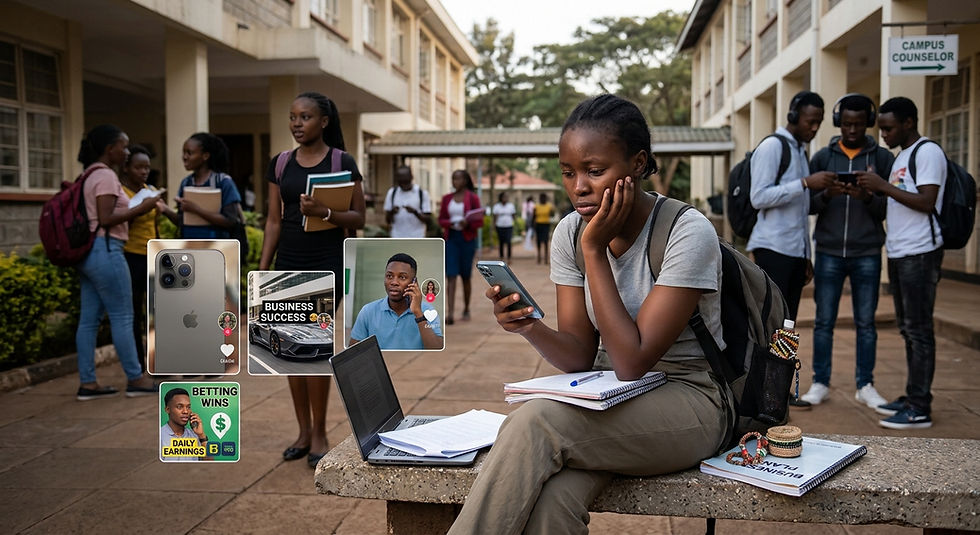
However, the attraction of quick money changes his perspective when he notices his peers acquiring expensive cars and displaying bundles of cash.
“I used to see people my age drive big cars and flaunt cash and I kept on asking what they were doing that I wasn’t. I wanted to know the secret as well,” he tells the Daily Nation.
His proximity to one of the alleged ‘sharp boys’ exposes him to a more lucrative but illegal business.
Shamir describes how personal information belonging to American citizens is allegedly obtained through underground online markets and used to create fraudulent student applications. He also explains how participants recruit academic writers to complete coursework for fictitious students.
The arrangement creates an unusual relationship between two industries. On one side is academic writing, where young Kenyans earn money completing assignments for foreign students. On the other is identity theft, where the same skills can be exploited to keep fictitious students enrolled and financial aid flowing.
The money involved makes the operation particularly attractive. Shamir tells the newspaper that some participants seek to process multiple applications, knowing that even a few successful applications can generate substantial returns.
But the process requires American-based intermediaries. These individuals receive the financial aid refunds through local banking channels and facilitate the movement of money to their Kenyan associates, sometimes retaining a share of the proceeds.
The scale of the operation is now attracting attention from law enforcement agencies on both sides of the Atlantic.
In its October 29 announcement, the DOJ reveals that investigators have identified 830,840 potentially fraudulent Federal Student Aid identification numbers linked to nearly $130 million and recommend that the Department of Education disable them.
The investigation also exposes different networks operating across several American states. In New Jersey, three defendants allegedly work with individuals in Kenya to obtain more than $1 million in federal student aid through fraudulent applications. The money passes through American bank accounts before being transferred overseas to alleged co-conspirators associated with a purported Kenyan safari company.
In another case in Virginia, prosecutors allege that a Kenyan national works with fraudsters in Kenya to obtain more than 700 fraudulent student aid refunds worth approximately $1.44 million. Investigators trace at least $1.3 million through thousands of financial transactions involving accounts in the United States and Kenya.
The crackdown is not limited to arrests and indictments. In September 2026, American investigators working with Kenyan law enforcement seize more than $750,000 in cryptocurrency from an account belonging to a Kenyan national connected to the wider fraud scheme. The DOJ describes the recovery as the first international seizure of its kind in the Fraud Division’s history.
Kenya’s Directorate of Criminal Investigations (DCI), Asset Recovery Agency (ARA) and Office of the Director of Public Prosecutions (ODPP) are among the local institutions assisting the American authorities.
In September, American investigators also visit Kenya to discuss extradition, prosecution and the recovery of money allegedly stolen from American taxpayers. Their presence signals that the investigation is moving beyond identifying fraudulent applications towards pursuing the people and financial networks allegedly supporting the operation.
For Kenya, the case raises uncomfortable questions about the country’s growing digital economy and the use of technological skills in international financial crime.
The same internet access, digital literacy and technical abilities that create opportunities for young people to work remotely and serve international clients can also be exploited for criminal purposes. The challenge is not the technology itself, but how individuals choose to use it.

For every fraudulent application, there is an American citizen whose identity is compromised, an educational institution processing a fictitious enrolment and a public financial assistance program losing money intended for genuine students.
The consequences extend beyond the immediate financial losses. Victims may have to dispute fraudulent accounts, challenge loans appearing on their credit records and spend time proving that they never attended the institutions associated with their names. Meanwhile, educational institutions and government agencies face the additional burden of identifying fraudulent applications and strengthening verification procedures.
Legitimate students could also face more scrutiny as institutions and financial aid administrators tighten their systems to prevent further abuse.
The attraction of quick money is understandable in a country where unemployment and the rising cost of living continue to put pressure on young people. However, financial desperation cannot justify stealing another person’s identity or diverting public funds.
The so-called ‘sharp boys’ may appear clever among their peers, but there is nothing entrepreneurial about building wealth from another person’s identity. Behind every successful fraudulent application is a victim who could spend years dealing with financial consequences for an education he never receives.
And perhaps that is the biggest irony of this business: while some young Kenyans celebrate money earned from America’s education system, an unsuspecting American may be left carrying the debt for a classroom he never enters.
The boys may call it being sharp. The law calls it fraud.


Superb